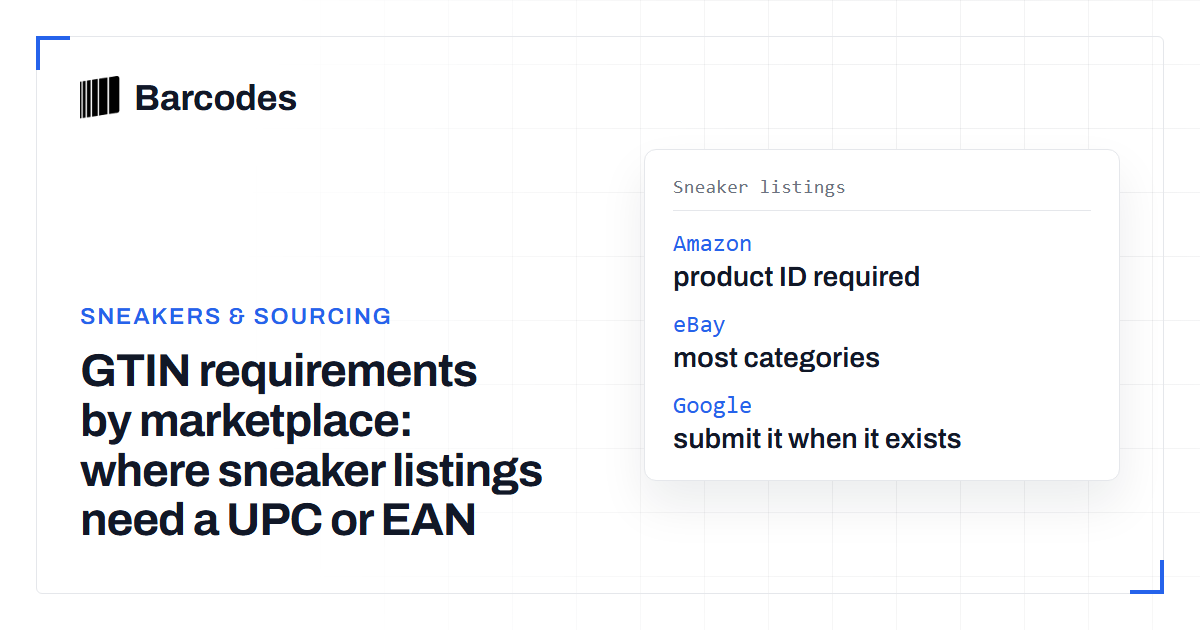
GTIN requirements by marketplace: where sneaker listings need a UPC or EAN
Each sales channel treats the barcode number on a shoe box differently. This guide sets out what Amazon, eBay, Google Merchant Center, Shopify, StockX and GOAT say in their own documentation. It also covers what happens to a footwear listing that arrives without a GTIN.
The short answer
Three of the six channels in the comparison table ask for the manufacturer GTIN on branded footwear. The other three do not make it a condition of listing.
- Amazon requires a product ID to create a new listing in most categories, and its category table lists no exception for Shoes, Handbags & Sunglasses.
- Google Merchant Center expects the GTIN whenever the manufacturer assigned one. Leaving it out limits visibility and can lead to disapproval.
- eBay says product identifiers are required in most categories and gives a "Does not apply" option for items that have none.
- Shopify does not require a barcode on a product, but the channels you publish to from Shopify may.
- StockX uses the GTIN as its first matching key for Shopify inventory and falls back to its Style ID. Manual listings are made by product name or style ID.
- GOAT tells sellers to search by SKU. Its help article does not mention a UPC.
A GTIN is the number printed under the barcode on the box label. On sneakers it is usually a 12-digit UPC or a 13-digit EAN, and every size of a shoe has its own. If the terms are new, start with what a GTIN is and GTIN vs UPC.
Comparison table
Every row was checked against the channel's own documentation on 2 October 2026. Rules change, so follow the source link before you rebuild a feed around this table.
| Channel | Is a GTIN required | Which identifier | What happens if it is missing | Official source |
|---|---|---|---|---|
| Amazon | Yes, to create a new listing in most categories. Shoes, Handbags & Sunglasses: product ID required, exceptions listed as none | UPC, EAN, JAN or ISBN | A new listing cannot be created without a product ID or an approved exemption. UPCs that do not match GS1 records are treated as invalid and removed | Product ID requirements by category |
| eBay | Required when listing in most categories, according to Seller Center | UPC, EAN or ISBN, or a brand and MPN pair | You can select "Does not apply" when the item has no identifier. Using it when the manufacturer provided one breaks the item description policy | Seller Center: product identifiers |
| Google Merchant Center | Expected for every product that has a manufacturer GTIN | gtin (UPC, EAN, JAN, ISBN, ITF-14). Without a GTIN: brand plus mpn | Limited visibility. Google also states the product could be disapproved | GTIN attribute |
| Shopify | No. The Barcode field is not mandatory on a product | GTIN, UPC, EAN, ISBN, ASIN or a custom value | Nothing in the store itself. Sales channels may refuse to publish the product | Product details |
| StockX | Not for manual listings. It is the primary matching key for the Shopify integration | GTIN in the Shopify Barcode field, or StockX Style ID with size chart and size | The integration falls back to Style ID matching, then to manual Smart Matching | Shopify onboarding guide |
| GOAT | No GTIN rule found in GOAT help | SKU (the style code on the box or inside the item) | Not stated | How do I submit items |
Amazon: a product ID is required for shoes
Amazon states that "for most categories, you are required to provide a unique product identifier, known as a GTIN (Global Trade Item Number), to create new listings" on its product ID requirements page. The IDs it names are UPC, ISBN, EAN and JAN.
The category table has a row for Shoes, Handbags & Sunglasses. Product ID required: yes. Exceptions and exemptions: none. The row is also marked as a category that needs approval before you can list. Clothing & Accessories reads differently: major brands require a UPC, and exemptions may be requested for private label brands.
Amazon checks UPCs against the GS1 database. Its Valid UPCs page says that UPCs which do not match GS1 information are considered invalid and that invalid UPC listings will be removed. It adds that ASIN creation or selling privileges may be removed temporarily or permanently. For a reseller of branded sneakers this means the only usable number is the one the brand printed on the box.
If the shoe is already in the Amazon catalog, you add an offer to the existing product page rather than creating a new one. The GTIN exemption route is for products that have no barcode at all. The detail is in eBay and Amazon UPC requirements for shoes.
eBay: required in most categories, with a declared opt-out
eBay's Seller Center says "product identifiers are required when you're listing in most categories on eBay" and counts UPCs, ISBNs and MPNs among them (source). The same page covers a product that has no identifier, such as an antique, or one you are not sure about. For those you can select "Does not apply".
That option has a limit. The item description policy covers required product identifiers such as Brand, UPC or MPN. When the manufacturer has provided that information, the policy does not allow inaccurate information such as "Does not apply", unbranded or generic, or "N/A". The policy lists removing the listing, a warning, restricted activity and account suspension as possible actions.
We did not find a current eBay page that states the rule for the shoe categories on their own. eBay's developer documentation says the requirement is set per category and should be read from its Taxonomy API. A new pair of branded sneakers has a manufacturer UPC on the box, so the practical reading is: enter it.
Google Merchant Center: submit the GTIN when one exists
Google's gtin attribute page marks the attribute as recommended for all products with a GTIN assigned by the manufacturer. The same page says that products with missing or incorrect GTINs may have limited visibility. It also says that if a product does have a GTIN assigned and you do not submit it, the product could be disapproved.
Google is explicit about variants: each product and each variant, meaning different colors or sizes, has its own GTIN. A sneaker in fourteen sizes is fourteen GTINs in the feed. When a product has no manufacturer GTIN, the mpn attribute becomes required alongside brand.
The attribute rules, the size-variant setup and the common disapprovals are covered in Google Merchant Center GTIN for sneakers.
Shopify: optional in the store, required by the channels
Shopify treats the barcode as an optional product detail. Its product details documentation describes barcodes as identifiers for products and variants, used for scanning and for product identification in online marketplaces. The accepted types are GTIN (8, 12, 13 or 14 digits), UPC, EAN, ISBN, ASIN and a custom value. The page also says you can add up to 20 barcodes to a product or a variant. The same value cannot be used twice on the same product or variant.
The requirement arrives with the sales channel. Shopify notes that some sales channels might require a GTIN before a product can be published. For the Google & YouTube channel, Shopify's requirements page says that if a product has a GTIN, you need to add it before you can publish the product. Products without one need an MPN and brand. For Marketplace Connect, Shopify states that Amazon, Walmart, eBay and Target Plus require each product to have a unique product identifier. Sellers of products without one, such as private label goods, need to apply for an exemption from those marketplaces.
For a sneaker store this means the Barcode field on each size variant is the one place to maintain the number. Every channel connected to the store reads it from there.
StockX and GOAT: catalog matching, not a GTIN field
StockX and GOAT sell from their own catalogs. A seller does not create a product page, so there is no listing form that demands a UPC. The identifier matters at the point where your inventory is matched to their catalog.
StockX. In StockX Pro you search by product name or style ID and then select a size. The Shopify integration works differently. The StockX onboarding guide for Shopify says products are primarily matched to the StockX catalog using the GTIN in the Shopify Barcode field. If no GTIN match is found, the system tries the StockX Style ID product metafield together with the StockX Size Chart and StockX Size metafields. StockX describes that method as less reliable than GTIN matching. Products that match on neither appear in a Map Products queue with suggested matches that you approve or reject (Smart Matching).
GOAT. The GOAT help article on submitting items says to start by searching for the SKU, which can be found on the box or inside the item. You then enter the condition and price and take the required photos (source). It does not mention a UPC, EAN or GTIN. We found no GOAT help page that sets a barcode requirement, so we do not claim one exists.
Poizon and Vinted are left out of this guide. We could not find an official page from either that states a GTIN rule for footwear listings.
Ceneo in Poland: EAN connects offers to products
In Poland, Ceneo uses EAN codes alongside other product attributes to match offers to product cards. See KC Mobile's Ceneo integration guide for the XML feed fields and setup steps for WooCommerce and PrestaShop.
What this means for size variants
A style code identifies a shoe model in one colorway. A GTIN identifies one size of it. Amazon, Google and the StockX integration all work at the GTIN level. A listing for a shoe in a full size run needs one number per size, taken from the label of that size.
Three checks prevent most rejected rows:
- Keep the digits as text. A spreadsheet that stores a UPC as a number drops the leading zero.
- Confirm the check digit with the check digit calculator or run the whole column through the barcode validation tool.
- Use one width per channel. The GTIN converter pads a 12-digit UPC to 13 or 14 digits without changing its meaning.
The style code tells a marketplace which shoe it is. The GTIN tells it which size is in the box.
Barcodes.gg
Where a barcode database helps
A barcode database answers two questions for a seller. Given a number scanned from a box, which product and size is it. Given a style code, which GTINs belong to its sizes.
The free sneaker barcode lookup answers the first. Enter the digits and it shows the product name, image, brand and barcode type. That is enough to confirm that the number in your feed belongs to the shoe you think it does. The second is reverse lookup from a style code to the barcode of every size. It is available through the API on Plus plans and Enterprise, and it is the practical way to fill the Barcode field for a large catalog. It does not replace the box label as the source of truth. A marketplace verifies the number against its own records, so check any value you did not read from the label yourself.
Frequently asked questions
Which marketplaces require a GTIN for sneakers?
Amazon requires a product ID to create a new listing in most categories and lists no exception for Shoes, Handbags and Sunglasses. Google Merchant Center expects the GTIN for every product that has one. eBay says product identifiers are required in most categories. Shopify, StockX and GOAT do not make a GTIN a condition of listing.
Does StockX require a UPC to sell?
StockX does not ask for a UPC when you list manually. You search its catalog by product name or style ID and choose a size. The StockX Shopify integration uses the GTIN in the Shopify Barcode field as its primary matching key and falls back to the StockX Style ID.
Does GOAT require a barcode to list sneakers?
GOAT help tells sellers to search for the SKU found on the box or inside the item. The article does not mention a UPC, EAN or GTIN, and we found no GOAT help page that sets a barcode requirement.
Do I need a separate GTIN for every shoe size?
Yes. Each size of a shoe is a separate trade item with its own GTIN. Google states that each variant, meaning different colors or sizes, has its own GTIN. Marketplaces that match on GTIN treat each size as a separate product.
Try the tools
GTIN converter
Pad a UPC to GTIN-13 or GTIN-14 for a feed that expects a fixed width.
Check digit calculator
Compute or verify the last digit of an EAN-13 before you submit it.
Barcode validation tool
Check length and check digit for a list of UPC and EAN values.
Sneaker barcode lookup
Enter a box-label barcode to confirm which shoe it belongs to.
Related reading
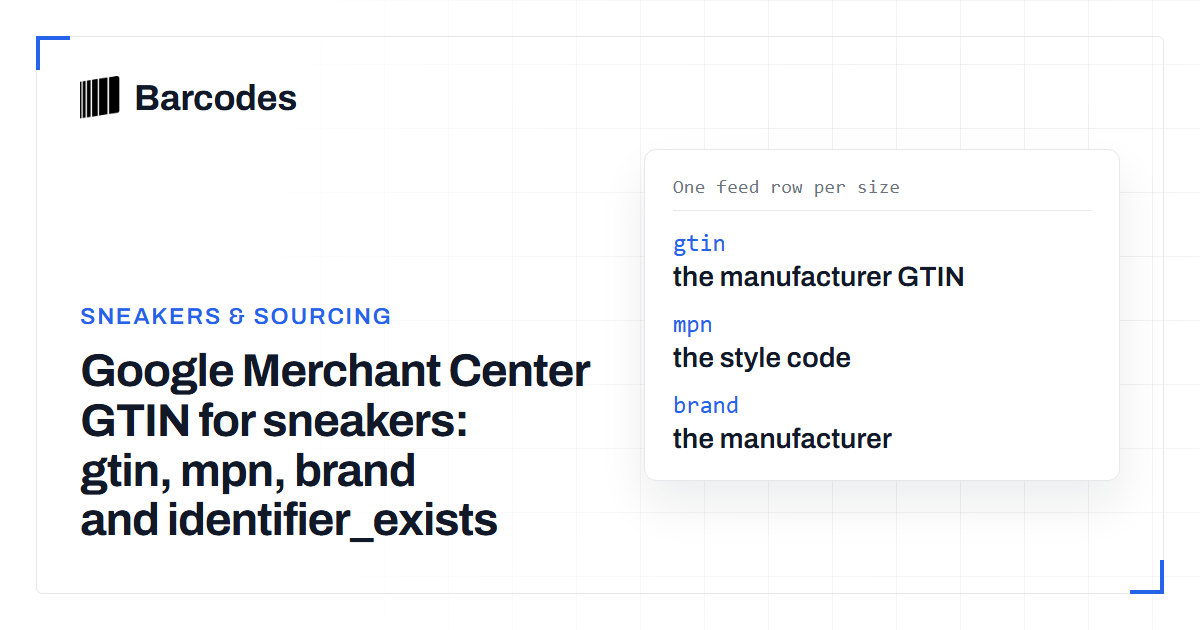
Google Merchant Center GTIN for sneakers: gtin, mpn, brand and identifier_exists
Branded shoes need the manufacturer GTIN for each size in a Merchant Center feed. The mpn, brand and identifier_exists attributes cover the cases where no GTIN exists.
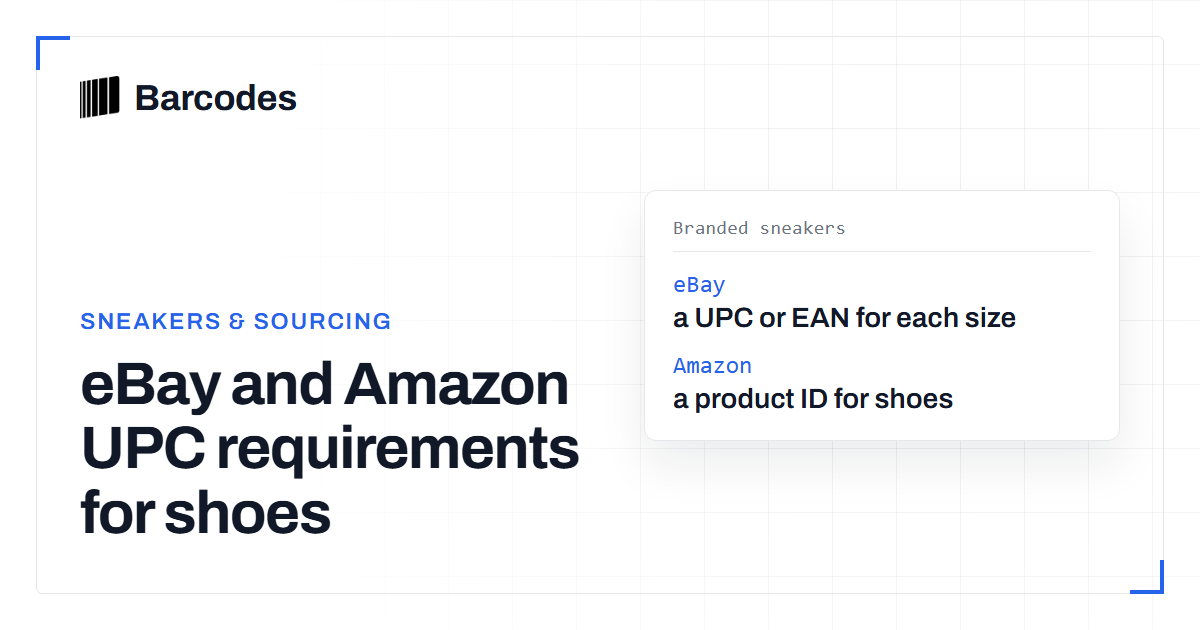
eBay and Amazon UPC requirements for shoes
Amazon requires a product ID for shoes and lists no exception for the category. eBay requires identifiers in most categories and limits when "Does not apply" may be used.
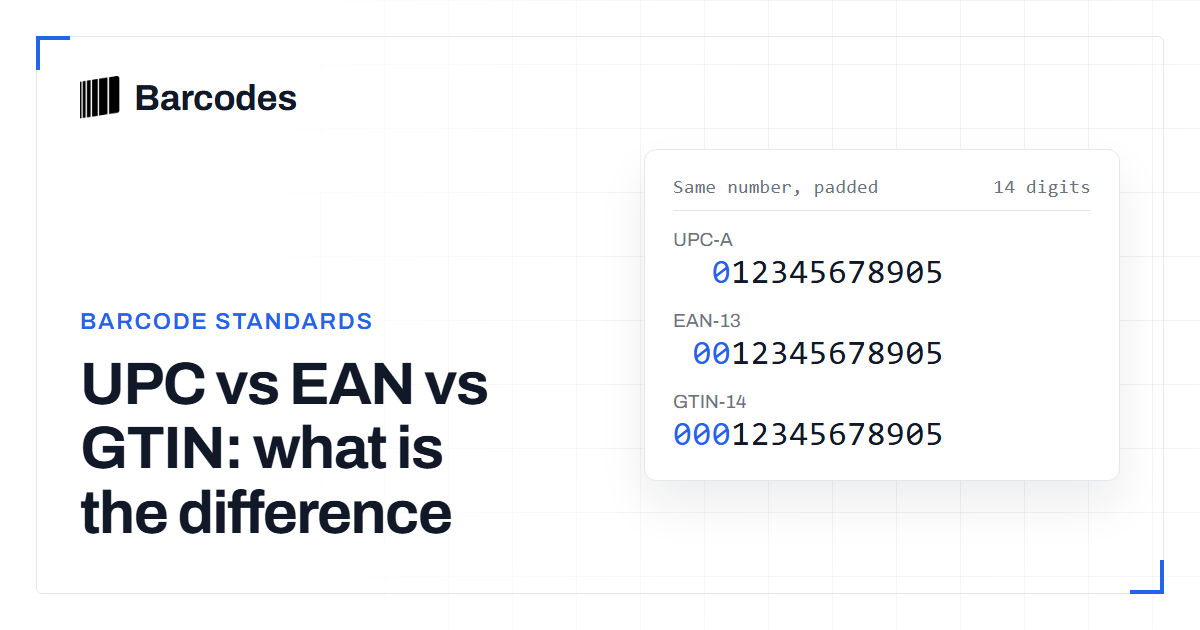
UPC vs EAN vs GTIN: what is the difference
UPC is not an alternative to GTIN. A UPC-A barcode carries a 12-digit GTIN-12, so UPC is one member of the wider GTIN family.
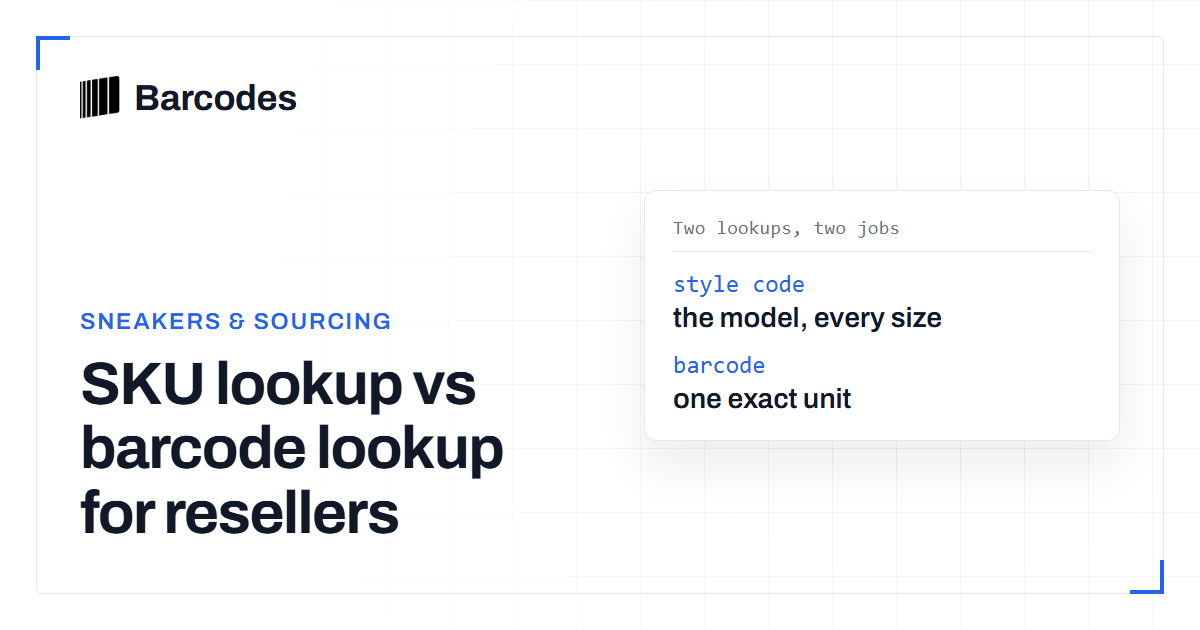
SKU lookup vs barcode lookup for resellers
The difference between looking up a product by SKU or style number and by barcode, and when to use each one for sourcing.