eBay and Amazon UPC requirements for shoes
Sellers of branded sneakers meet two different identifier systems on eBay and Amazon. This guide covers what each one asks for, how size variations carry their own UPC, and where Amazon's GTIN exemption does and does not apply.
Summary for sellers of branded sneakers
On both marketplaces, a new pair of branded sneakers should be listed with the UPC or EAN printed on its box.
- Amazon requires a product ID to create a listing in most categories. Its table lists Shoes, Handbags & Sunglasses with product ID required and no exceptions. A GTIN exemption is not available for a product that already has a GTIN.
- eBay says product identifiers are required in most categories. You may select "Does not apply" when the item has no identifier, and eBay policy does not allow that value when the manufacturer provided one.
| Question | eBay | Amazon |
|---|---|---|
| Accepted identifiers | UPC, EAN, ISBN, or a brand and MPN pair | UPC, EAN, JAN, ISBN |
| Where the rule is set | Per category | Per category, in one published table |
| Size variations | Identifier goes on each variation, never on the parent item | Not covered here. See the note in the Amazon section |
| No identifier exists | Enter the site's "Does not apply" text | Apply for a GTIN exemption |
| Identifier exists but is left out | Entering "Does not apply" instead breaks the item description policy | Exemption is not available |
eBay product identifiers
eBay defines product identifiers as unique codes created by the manufacturer and says they "are required when you're listing in most categories on eBay" (Seller Center). Its developer guide says most branded products sold on eBay must be associated with one or more recognised product identifiers. These can be a combination of brand, manufacturer part number and GTIN (catalog products).
The format rules are in the product identifiers guide:
- A UPC must comply with the GTIN-12 or UPC-A standard.
- An EAN must comply with the GTIN-13 standard.
- Brand must be the actual brand name. eBay gives "Brand new" as an example of an invalid entry.
For a sneaker, the UPC or EAN is the number under the barcode on the box label. The brand is the manufacturer, and the MPN is the style code. A UPC that fails its check digit will not match a catalog product. Verify typed values with the UPC check digit calculator or the EAN check digit calculator.
We could not find a current eBay page that states the identifier rule for the shoe categories specifically. eBay's API reference says to call the Taxonomy API method getItemAspectsForCategory to see whether UPC is required, recommended or optional for a given category (reference).
When "Does not apply" is allowed on eBay
"Does not apply" is for items that have no identifier. Seller Center says you can select it in two cases: the product you are listing has no identifier, such as antiques, or you are not sure what it is. The developer documentation covers a listing category that requires a GTIN when the product lacks one. In that case you provide the substitute text for the listing site (product identifier text). The text is site specific: "Does not apply" on eBay US and UK, "Nicht zutreffend" on eBay Germany, "Non applicable" on eBay France, "Non applicabile" on eBay Italy and "No aplicable" on eBay Spain.
It is not allowed as a shortcut. The item description policy covers required product identifiers such as Brand, UPC or MPN. When the manufacturer has provided that information, the policy lists as not allowed the use of inaccurate information such as "Does not apply", unbranded or generic, or "N/A". The actions eBay names for breaking the policy include removing the listing, issuing a warning, restricting activity and suspending the account.
A used pair with no box is a real case for "Does not apply", because you cannot read a UPC that is no longer there. A new pair with its box is not. The number is on the label.
eBay size variations: one identifier per size
In a multiple-variation listing, the UPC or EAN belongs on each variation. eBay's guide to product identifiers in multiple-variation listings sets four rules that matter for a size run:
- The product identifier must be specified only at the variation level.
- All variations within a single listing must use the same product identifier type. Mixing an EAN on one size with UPCs on the others returns an error.
- If an identifier is supplied at the item level for a multiple-variation listing, the add, revise or relist call fails.
- The MPN can vary between variations. The brand cannot.
The same-type rule is the one that catches sneaker sellers. Stock bought in the US carries 12-digit UPCs, and stock bought in Europe often carries 13-digit EANs for the same shoe. A UPC with a leading zero added is a valid EAN-13, so you can express a mixed size run in one type. The GTIN converter does the padding.
Listing: one model, one colorway
  Brand  set once at item level
  Size 8    UPC from the size 8 box
  Size 8.5  UPC from the size 8.5 box
  Size 9    UPC from the size 9 box
All sizes use the same identifier type (all UPC or all EAN).
Amazon: the GTIN requirement for shoes
Amazon requires a product ID to create a new listing in most categories, and the shoe category has no listed exception. The Seller Central page on product IDs names UPC, ISBN, EAN and JAN as the commonly used GTINs. It says the specific requirement varies by category.
The requirements by category table (United States) contains these two rows:
| Category | Product ID required | Exceptions and exemptions |
|---|---|---|
| Shoes, Handbags & Sunglasses | Yes | None |
| Clothing & Accessories | Yes | Major brands require a UPC, but exemptions may be requested for private label brands |
Both rows are marked as categories that require approval before you can list.
Amazon verifies the numbers. Its Valid UPCs page says it checks UPCs against the GS1 database, and that UPCs which do not match GS1 information are considered invalid. It says all invalid UPC listings will be removed and may result in ASIN creation or selling privileges being removed temporarily or permanently. A UPC bought from a reseller of barcodes will not show the shoe brand as its owner in GS1 records.
Most branded sneakers already exist in the Amazon catalog. In that case you add your offer to the existing product page. Amazon's listing errors guide says a product ID error can mean two things. You are trying to create a new detail page for a product that is already listed, or the ID you entered is associated with a different product. The guide tells sellers to make sure they enter the exact GTIN that appears on the product's barcode. The Amazon pages we read do not describe how product IDs attach to size variations, so that part is not covered here.
Amazon GTIN exemption: not for branded sneakers
A GTIN exemption lets you list a product that has no product ID. It does not let you skip the ID on a product that has one. Amazon's page on listing products that do not have a product ID sets three starting conditions. The product is not in the Amazon catalog. The product has no product ID or GS1 barcode. You have category approval if it is required.
Amazon says you can apply if you sell:
- private-label or handmade products
- products you manufacture, brand or publish without barcodes
- parts without a product ID
- bundled products
- generic, unbranded products
You cannot apply if the product has an existing GS1-approved barcode, has an existing GTIN, EAN, UPC or ISBN, is from a brand requiring a mandatory UPC, or is available in the Amazon catalog. A retail pair of Nike, Jordan, adidas or New Balance shoes has a manufacturer barcode on the box. It falls under the second condition at least.
For sellers who do qualify, Amazon asks for real-world photos of all sides of the product and packaging, with the brand name permanently affixed. Its guide to generic products says approval usually arrives within 48 hours.
The category table lists no exemption for Shoes, Handbags & Sunglasses, while the exemption page describes eligibility by product, not by category. We did not find an Amazon page that says whether an exemption is granted for private-label footwear. The application tool in Seller Central gives the answer for your account.
Where a barcode database helps
Both marketplaces want the manufacturer number for the exact size, and both check it. A barcode database is useful in two cases. You hold stock by style code and size but did not record each box label. Or you need to confirm that a number typed into a listing belongs to the shoe in hand.
The free sneaker barcode lookup takes a barcode and shows the product name, image and brand, which is a quick check before you submit. Run a full column through the barcode validation tool to find wrong lengths and bad check digits. Going the other way, from a style code to the barcode of every size in bulk, is an API feature on Plus plans and Enterprise. Neither marketplace accepts a database as proof of anything. Amazon checks GS1 records, so use lookup results to fill and verify your own data, with the box label as the reference.
For the other channels, see GTIN requirements by marketplace. For Shopping feeds, see Google Merchant Center GTIN for sneakers.
Frequently asked questions
Does eBay require a UPC for shoes?
eBay says product identifiers are required when listing in most categories, and sets the exact rule per category. We found no current eBay page that states the rule for shoe categories on their own. eBay policy does not allow entering Does not apply for a UPC when the manufacturer provided one, so a new boxed pair should be listed with its UPC.
Can I get an Amazon GTIN exemption for branded sneakers?
No. Amazon states that you cannot apply for a GTIN exemption if the product has an existing GTIN, EAN, UPC or ISBN or an existing GS1-approved barcode. Branded sneakers carry a manufacturer barcode, and the Amazon category table lists no exceptions for Shoes, Handbags and Sunglasses.
Does each shoe size need its own UPC on eBay?
In an eBay multiple-variation listing the product identifier is specified only at the variation level, so each size carries its own UPC or EAN. All variations in one listing must use the same identifier type.
What happens if I use a purchased UPC on Amazon?
Amazon checks UPCs against the GS1 database and treats values that do not match GS1 information as invalid. Amazon states that invalid UPC listings will be removed and that ASIN creation or selling privileges may be removed temporarily or permanently.
Try the tools
GTIN converter
Express a mixed set of UPCs and EANs in one identifier type.
Check digit calculator
Verify the last digit of an EAN-13 typed from a box label.
Barcode validation tool
Check a list of UPC and EAN values before a bulk upload.
Sneaker barcode lookup
Confirm which shoe a barcode belongs to before you list it.
Related reading
GTIN requirements by marketplace: where sneaker listings need a UPC or EAN
Amazon and Google ask for the manufacturer GTIN on branded shoes. eBay asks for it in most categories. StockX and GOAT list by catalog match or style code.
Google Merchant Center GTIN for sneakers: gtin, mpn, brand and identifier_exists
Branded shoes need the manufacturer GTIN for each size in a Merchant Center feed. The mpn, brand and identifier_exists attributes cover the cases where no GTIN exists.
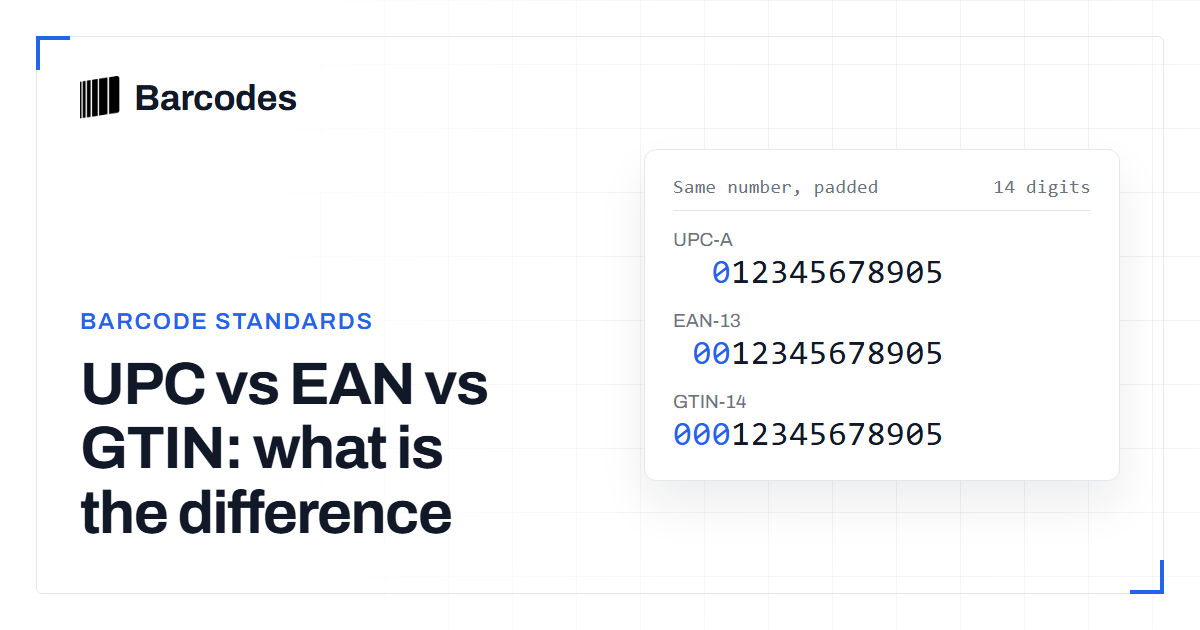
UPC vs EAN vs GTIN: what is the difference
UPC is not an alternative to GTIN. A UPC-A barcode carries a 12-digit GTIN-12, so UPC is one member of the wider GTIN family.
SKU lookup vs barcode lookup for resellers
The difference between looking up a product by SKU or style number and by barcode, and when to use each one for sourcing.