Sneaker size premium: the size tax on StockX
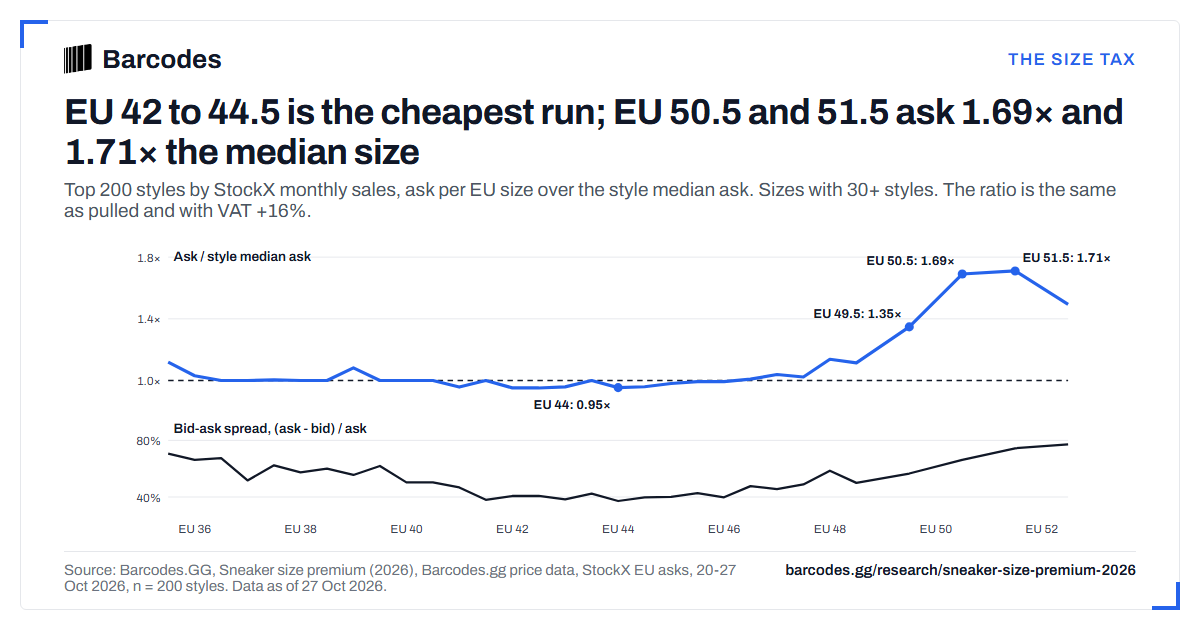
On StockX in Europe, the size you wear moves the price more than most buyers expect. For the 200 best sellers, EU 42 to 44.5 asks 4 to 5 % below the middle of the size run. EU 49.5 asks +35 %, and EU 50.5 and 51.5 about +70 %. If you wear a large size, retail is your best price. If you sell, a single price per style hides most of your margin.
Data as of · Barcodes.GG (Reactive Systems SL)
- −5 %
- EU 42 to 44.5: up to 5 % below the median size of the same style
- +35 %
- EU 49.5 over the median size
- +71 %
- EU 51.5 over the median size (EU 50.5: +69 %)
- 37 % → 77 %
- median bid-ask spread: mid sizes (37 to 41 %) against the largest sizes (74 to 77 %)
The finding in short
A resale price is a price per size. We divided the ask of every EU size by the median ask of the same style, for the 200 styles with the most StockX monthly sales in Barcodes.gg price data, week to 27 October 2026.
- The cheapest run is EU 42 to 44.5, at 4 to 5 % below the median size.
- From EU 47 the ask climbs: +11 % at EU 48.5, +35 % at EU 49.5, +69 % and +71 % at EU 50.5 and 51.5.
- The bid-ask spread doubles from 37 to 41 % in the mid sizes to 74 to 77 % in EU 51.5 and 52.5.
- In the median style, the most expensive size asks 2.5 times the cheapest size.
The size curve
The table gives, per EU size, the number of styles with an ask, the median ask over the style median and the bid-ask spread.
| EU size | Styles | Ask / style median | Difference | Bid-ask spread |
|---|---|---|---|---|
| EU 35.5 | 90 | 1.12× | +12 % | 71 % |
| EU 36 | 142 | 1.03× | +3 % | 66 % |
| EU 38 | 149 | 1.00× | same as median | 57 % |
| EU 40 | 193 | 1.00× | same as median | 50 % |
| EU 41 | 149 | 0.96× | −4 % | 47 % |
| EU 42 | 189 | 0.95× | −5 % | 41 % |
| EU 42.5 | 180 | 0.95× | −5 % | 41 % |
| EU 43 | 156 | 0.96× | −4 % | 38 % |
| EU 44 | 186 | 0.95× | −5 % | 37 % |
| EU 44.5 | 183 | 0.96× | −4 % | 40 % |
| EU 45 | 162 | 0.98× | −2 % | 40 % |
| EU 46 | 178 | 0.99× | −1 % | 40 % |
| EU 47 | 141 | 1.04× | +4 % | 46 % |
| EU 48.5 | 140 | 1.11× | +11 % | 50 % |
| EU 49.5 | 128 | 1.35× | +35 % | 57 % |
| EU 50.5 | 94 | 1.69× | +69 % | 66 % |
| EU 51.5 | 77 | 1.71× | +71 % | 74 % |
| EU 52.5 | 78 | 1.49× | +49 % | 77 % |
The curve is a wide U. It bottoms out between EU 41 and 45, rises gently up to EU 48.5 and then steeply. It turns down again at EU 52.5 (+49 %). Only 78 styles have an ask in that size, and they are a different, smaller set than the styles in the mid sizes, so the dip is weak evidence. The small sizes rise too, but less: EU 35.5 asks +12 %. The full curve, with the half sizes that few styles have, is in c1_size_curve.csv.
Why mid sizes trade under the median and big sizes far above
The median of a style sits in the middle of its size run, but sellers do not spread evenly over that run. Brands make the most pairs in the common adult sizes, so most resellers hold EU 42 to 45. Every new order goes to the lowest ask, and in a crowded size the lowest ask is a little below the rest of the run. That is the 4 to 5 % discount.
Large sizes are the opposite. Many styles stop at EU 48.5 or 49.5, and the larger pairs that exist are few. A buyer with EU 50.5 feet has no shop alternative once the release is gone, and the few sellers know it. The ask reflects scarcity, not cost: the shoe costs the same to make in every size.
The spread confirms it. In EU 43 and 44, the spread is 38 % and 37 %: buyers bid close to the ask, and pairs sell fast. At EU 49.5 it is 57 %, and at EU 52.5 77 %. Few buyers bid on those sizes, so a pair can carry a high ask and still wait for weeks. A high ask in a large size is therefore not a high price paid.
By brand
The table gives the curve for the four brands with enough styles in the top 200; "n/a" means that the CSV has no value for that brand and size.
| Brand | EU 36 | EU 40 | EU 42 | EU 44 | EU 46 | EU 48.5 | EU 49.5 | EU 50.5 | EU 51.5 | EU 52.5 |
|---|---|---|---|---|---|---|---|---|---|---|
| Jordan (up to 84 styles) | 1.04× | 1.00× | 0.96× | 0.92× | 0.96× | 1.13× | 1.37× | 1.75× | 1.78× | 1.45× |
| Nike (up to 48 styles) | 1.02× | 1.00× | 0.91× | 0.96× | 0.99× | 1.08× | 1.20× | 1.43× | 1.52× | 1.94× |
| adidas (up to 13 styles) | 0.87× | 0.99× | 0.92× | 1.00× | 1.00× | n/a | 1.37× | n/a | n/a | n/a |
| ASICS (up to 13 styles) | 1.09× | 0.99× | 0.95× | 0.99× | 0.98× | n/a | n/a | n/a | n/a | n/a |
Jordan has the steepest curve: EU 44 asks 0.92× and EU 51.5 asks 1.78× the median size. Nike has its lowest ask at EU 42 (0.91×) and its highest at EU 52.5 (1.94×). The spreads follow the same shape: Jordan has 34 % at EU 44 and 76 % at EU 52.5. The adidas and ASICS groups have 13 styles or fewer, so read them as an indication.
Flex or direct: does consignment cost more?
StockX Flex is the consignment programme: the seller stores the pairs at StockX, and the buyer gets faster shipping. The table compares the Flex ask with the direct ask for the same style, market, day and size, over the last 60 days in our price cache.
| Group | Styles | Median Flex / direct |
|---|---|---|
| All styles | 334 | 1.006 |
| Nike | 109 | 1.006 |
| adidas | 67 | 1.000 |
| Jordan | 54 | 1.073 |
| ASICS | 22 | 1.000 |
| Other brands | 22 | 1.000 |
Over 334 styles and 5,253 size pairs, the median Flex ask is 1.006 times the direct ask. Flex was dearer for 51.8 % of the styles and cheaper for only 9.6 %; in a quarter of the styles it was 18 % dearer or more. Jordan shows the largest gap (1.073). Faster shipping has a price, and some buyers pay it. The sample is small: quote it as "in a sample of 334 styles". The file also holds an Alias row built from global price indicators, not regional asks; we draw no conclusion from it.
Women and kids sizes
We cannot show a women or kids curve. The catalogue gives a gender for 72 of the 200 styles: 66 men, 5 women and 1 kids. The men curve (gender:men in the CSV) matches the total. The small EU sizes here are mostly small men or unisex sizes, not a women run.
What this means for you
If you buy: if you wear EU 49 or more, buy at retail on release day; on resale the same shoe asks up to +71 % more. In a large size, place a bid under the ask: the wide spread means that sellers wait too. If you wear EU 42 to 44.5, resale is cheapest for you, and bids sit closest to the ask.
If you sell: price each size on its own. A style average overprices the mid sizes, which then do not sell, and underprices the large ones. Mid sizes turn over fast at a small margin; large sizes carry a margin but tie up cash. Prices per size by style code or by the barcode of one size come from the sneaker price API.
Caveats in plain words
- An ask is an offer, not a sale. A large-size pair can sit at a high ask without a buyer.
- The extreme sizes rest on fewer styles (EU 52.5: 78).
- The study covers the 200 best sellers. Limited releases can have a different curve.
- The Flex comparison is a small, separate sample.
Method
Sample. The newest StockX snapshot per style code in Barcodes.gg price data between 20 October and 27 October 2026, in EUR, without Flex asks. The top 200 styles by StockX monthly sales with an ask in 8 sizes or more.
Ratio. The ask of a size divided by the median ask over the sizes of the same style; sizes rounded to the nearest half size. The chart shows sizes with 30 styles or more. The spread is (ask − bid) / ask in the same snapshot.
VAT. The StockX asks in this study come from a VAT-registered seller view of the StockX EU market (market code ES.vat-registered). Such an ask can sit below the price that a consumer sees. For 45 styles, we compared both views for the same style, country and size over 120 days. The consumer ask was a median 1.16× the VAT-registered ask, or about 16 % higher. Ratios of an ask to a retail price therefore have two forms: "as pulled" (the VAT-registered ask) and "VAT +16 %" (the same ask with 16 % added back).
On this page, each ratio divides one ask by another ask from the same view, so the VAT factor cancels out. The size ratios are the same as pulled and with VAT +16 %, and the page shows no absolute price.
Downloads
Each file holds medians, shares or counts only. No file holds a single price, a barcode or personal data. Free for editorial use with a link to Barcodes.GG.
- c1_size_curve.csv: Ask per EU size over the style median ask, and the bid-ask spread, overall, by brand and by gender
- d2_consign_vs_direct.csv: Consignment ask over direct ask, same style, day and size
- d2_consign_vs_direct_by_brand.csv: Consignment ask over direct ask by brand
- g4_price_facts.csv: Size-level facts: most expensive size over cheapest size
- d3_vat_registered_check.csv: Consumer ask over VAT-registered ask, same style and size
- method_facts.csv: Method facts: sample, thresholds and gender coverage
- chart-size-curve.png: chart, ask per EU size over the style median, and the bid-ask spread (1200 × 630 PNG)
How to cite
Barcodes.GG (Reactive Systems SL). Sneaker size premium: the size tax on StockX (2026). Data as of 27 October 2026. https://barcodes.gg/research/sneaker-size-premium-2026
Free for editorial use with a link to Barcodes.GG. Please link this page, not a tool page, so readers can find the method and the files.
Cited by
No article has cited this study yet. If you use a figure, write to mail@barcodes.gg and we will list your article here.
Free for editorial use with a link to Barcodes.GG.
Frequently asked questions
Which sneaker sizes are cheapest on StockX?
EU 42 to 44.5. For the top 200 styles on StockX in Europe, these sizes ask 4 to 5 % below the median size of the same shoe.
Is StockX Flex more expensive than a direct ask?
Slightly. In a sample of 334 styles, the median Flex ask was 1.006 times the direct ask, and Flex was dearer for 51.8 % of the styles.
Is there a size curve for women or kids?
No. The catalogue gives a gender for 72 of the 200 styles, and only 5 of them are women styles.